
Tripods
You must own a tripod! That 3 legged support structure is one of the oldest tools known to mankind. They hold pots over a fire, were used in sacrificial ceremonies and support machine guns in war time.
Now, tripods provide portable stability and sharper images for a variety of photographic techniques. Long exposure pictures taken in low light that would blur if the camera moved can be sharp and vibrant with the stable support of a tripod. A telephoto lens will amplify any camera movement and easily blur your picture. A tripod, and, in fact, any stable surface, can help keep those pictures in focus.
Note: Nikon recommends that you turn off Vibration Reduction (VR) when using a tripod. VR starts a gyroscope when you hold the shutter release down halfway that helps stabilize a hand held camera, but can induce movement and vibration when the camera is supported on a tripod, especially when using a telephoto lens.
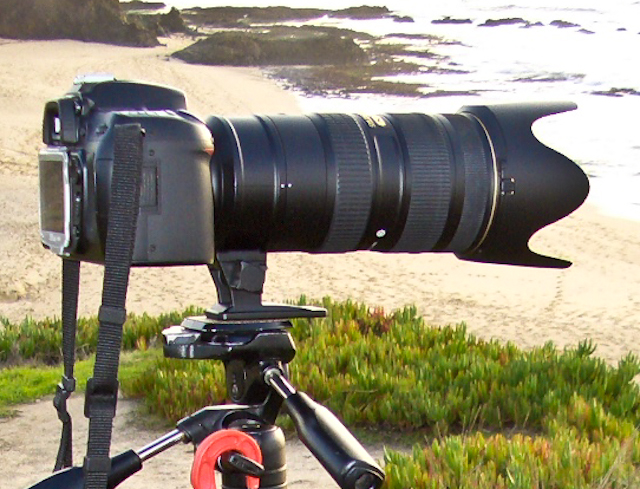
Tripods come in a variety of sizes, strength and quality as do the camera mount heads. What you need depends on your camera and application and is beyond the scope of this post. Suffice it to say that heavier cameras require stronger (and more expensive) tripods. Here is a nice informational article on Wikipedia.
But there are tips to improve the performance of any tripod. First, check the bottom of your camera. Most have the standard size (1/4 inch, 20 threads per inch) screw socket, ready to attach to a standard tripod. Camera mounted? Let’s go.
Keep your tripod short. Shorter is more stable. I do not extend the legs any longer then I need to. And I only raise the center pole as a last resort!
Add weight. Since a heavier support is more stable, you can improve the performance of your inexpensive tripod by hanging weight from the center. Some tripods include a hook at the bottom of the center pole. I carry a bungie cord for this purpose and use my camera bag as the weight. Tying the tripod to a secure point embedded in the ground is even better but less portable. This is a big help for long exposures.

If it is windy, I will stand upwind with my coat open like a flasher trying to protect the camera from moving. Every little bit helps.
Small tripods for small cameras are useful too. Gorilla Pod makes a popular flexible leg tripod that will wrap around a pipe or chair back.


Some people make their own tripods. You can see a wide variety at Instructables.com.
I find that an unintended advantage to using a tripod is that it slows me down. Moving and framing takes more effort and I find myself spending extra time thinking through the shot.
You might want to add a mono pod to your collection. They add stability, are easy to carry and can be used in places where tripods would be awkward or forbidden. Even using a mono pod, I look to support it against something solid, such as a railing. Place the base firmly against your foot or even inside your shoe. And, again, shorter is more stable. Only extend it as far as you need to.
The idea is you can improve the sharpness of your photographs simply by creating a positive stable platform for the camera, whether it be on a $1000 tripod or the top of a fence post.
More focus to come…