
What I learned today: a definition of low key lighting.
From Wikipedia:
Low-key lighting is a style of lighting for photography, film or television. It attempts to create a chiaroscuro effect. In traditional photographic lighting, three-point lighting uses a key light, a fill light, and a back light for even illumination. Low-key lighting requires only one key light, optionally controlled with a fill light or a simple reflector.
Low key light accentuates the contours of an object by throwing areas into shade while a fill light or reflector may illuminate the shadow areas to control contrast. The relative strength of key-to-fill, known as the lighting ratio, can be measured using a light meter. Low key lighting has a higher lighting ratio, e.g. 8:1, than high key lighting, which can approach 1:1.
The term “low key” is used in cinematography to refer to any scene with a high lighting ratio, especially if there is a predominance of shadowy areas. It tends to heighten the sense of alienation felt by the viewer, hence is commonly used in film noir and horror genres.
I always understood the term in a venacular kind of way, meaning a kind of dark environment (a jazz club immediately comes to mind), but when I took on a recent project put forth at Utata, this is the first picture I entered.
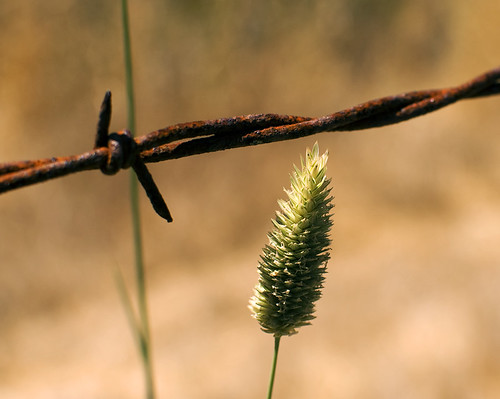
The project, entitled “Iron Photogrpher” to include a flower, something rusty and low key lighting. I felt the picture met 2 of the 3 criteria and I underexposed to try to meet the 3rd.
Placed alongside the other submitted pictures, my photo pops out much lighter then the others. So I thought deeper about the term and realized that “low key” is probably a technical term that I have given little thought to. How often have I seen “key grip” in the credits of a movie and not taken the time to look up what it means.
The Wikipedia definition actually and briefly explains normal photographic lighting as having 3 considerations, a “key” light being the most important (the “key” lighting illuminating the most important feature of the subject), a fill light to reduce contrast and a back light to further even out the shadows. Low key can result when you remove the fill and back lighting. It also suggests the “chiaroscuro effect” which defines a large contrast between light and dark throughout the entire picture.
An image search on Google shows many low key examples. And my image still appears too light.
I was thinking that my photo has only one light source, the sun, but the problem arises as the sun is reflected off the grass in the background, a backlight if you will that distracts from the contrast within the subjects, that is if you are aiming for “low key”.
So, I assume at this point that the pictures fails the 3rd criteria of low key lighting as is generally accepted and I need to try again. Maybe this can be salvaged using Photoshop to alter the background. Maybe an off camera flash, controlling the ambient light of the background with a fast shutter speed would accomplish the feat.
Maybe the pictured failed but, FTW, the reason I impose projects on myself is to incite me to shoot and hopefully learn somethng I did not know before.