
In the last workshop, we talked of photo opportunities in our backyard, one of which occurs when there is a “minus tide”. Essentially, a minus tide is a relatively rare, very low ocean water level condition that exposes a large amount of reef or ocean bottom. The coast here has a vast amount of shallow reef that, at a very low tide, traps many marine animals and exposes underwater plant life not normally seen while walking on the beach during regular tides.
I found this more technical explanation on the internet:
Jeff Renner
What’s a minus tide?
A minus tide, also sometimes called a negative tide, is an unusually low tide. Tide ‘heights’ are referenced to a base level set as zero. This level, called the ‘datum’, is the same level used to reference water depths on NOAA navigational charts.Usually, low tides still remain a bit above zero, often a foot or two above. But the swing from high tide to low tide levels is greatest when the sun and moon are either on exact opposite sides of the earth, or especially when they’re on the same side of the earth. This corresponds to a full or a ‘new’ moon. The gravitational ‘tug’ by both the sun and moon pull water toward them. As the earth rotates under the oceans, high tides occur when that part of the earth is facing either the moon or sun (or both). Low tides occur about six hours later, when the earth has turned ninety degrees away from either of those ‘bulges’ of water.
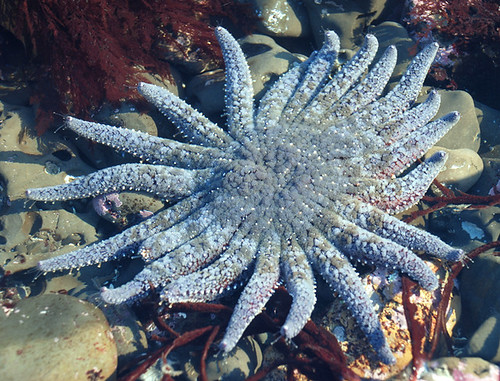
Sunflower Sea Star
This is indeed a photo opportunity to capture a wide variety of sea life provided the light is right and you are very careful with your equipment. Of course, you must consider the possibility of dropping your camera in the water. Even if the strap is securely around your neck, the rocks are slippery and if you fall in, your camera is going with you. These are things probably obvious to you but did not occur to me until I got out there for the first time.
But, if you are adventurous and except that risk, here are a few tips.
- Water proof boots help you get around easier and give you a bit more confidence.
- This is a good place to experiment with a polarizing filter which can reduce reflections on the surface of the water and provide better photographic access.
- Polarized sunglasses will also help your vision.
- Some kind of a reflector can be used to illuminate the critters hiding in the cracks or provide more direct light when the sun is low.
- I find a tripod to be a hindrance but you may want to try one if the lighting is poor.
When are these tides? Well, there are 2 low tides every 24 hours, but the times vary. You just need to know what time they happen and how low they will go. And you don’t necessarily need to wait for an absolute minus tide. Look for any tide near 0 and take a walk to the beach with your camera.
Click here to go to the daily tide chart adjusted for Half Moon Bay. The chart shows the tides 2 days at a time. Scroll down to find more search options and a link for the entire year. I see that that the minus tides for August and September will mostly be between 1am and 5am, when they do occur. October and November have some low tides on some late afternoons. The first week of December is looking good for some ‑1.50 foot tides.
Check out photos others have taken. Click here to go to Flickr pictures tagged with the words “fitzgerald and marine” which show many pictures from the Fitzgerald Marine Preserve in Moss Beach. The preserve is easily accessed and very popular during these low tides.
Click here to go to a tide pool group in Flickr.
The Half Moon Bay Review posted an article about the Fitzgerald Marine Preserve and how it recently gained enhanced protection status, a good thing with the state park closings looming over our heads. Click here to read it.
Well, that should keep you busy for a bit. Have fun and take some pictures!